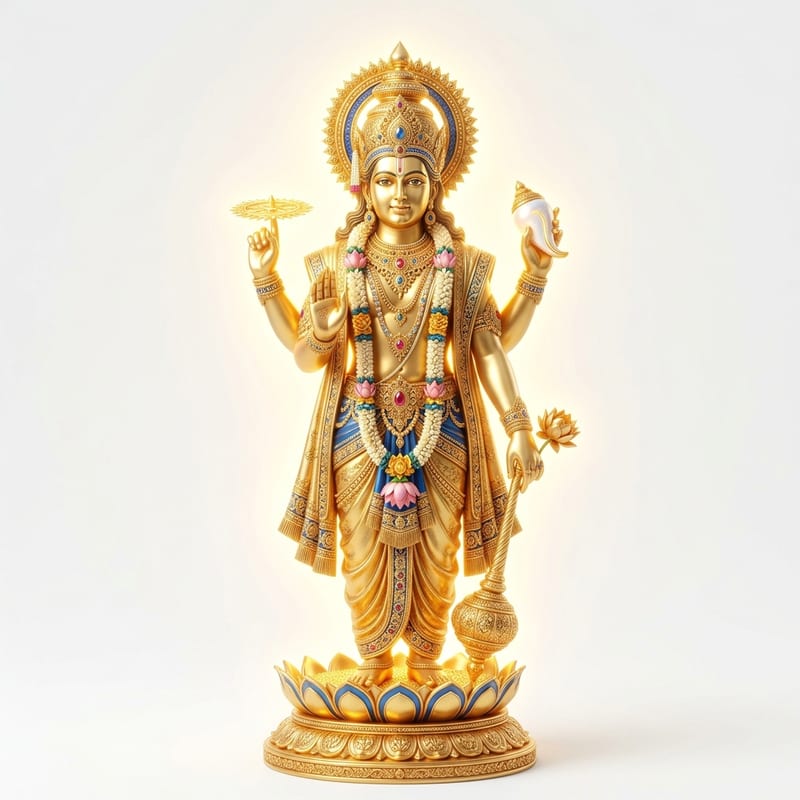
śrīviṣṇusahasranāmastotram
The Hymn of the Thousand Names of Lord Vishnu (Shri Vishnu Sahasranama Stotram).
oṃ
śrīparamātmane namaḥ |
nārāyaṇaṃ namaskṛtya naraṃ caiva narottamam |
devīṃ sarasvatīṃ vyāsaṃ tato jayamudīrayet ||
Om. Salutations to the Supreme Self (Paramatman). Having bowed down to Narayana, and to Nara, the best of men, as well as to the Goddess Sarasvati and Sage Vyasa, one should then utter the word of victory (Jaya).
oṃ atha sakalasaubhāgyadāyakaṃ śrīviṣṇusahasranāmastotram |
hariḥ oṃ ||
Om. Now begins the Shri Vishnu Sahasranama Stotram, which bestows all forms of prosperity and auspiciousness. Harih Om.
śuklāmbaradharaṃ viṣṇuṃ śaśivarṇaṃ caturbhujam |
prasannavadanaṃ dhyāyet sarvavighnopaśāntaye || 1||
One should meditate upon Lord Vishnu, who wears white garments, who is of the color of the moon, who has four arms, and who has a serene and cheerful countenance, for the pacification of all obstacles.
yasya dviradavaktrādyāḥ pāriṣadyāḥ paraḥ śatam |
vighnaṃ nighnanti satataṃ viṣvaksenaṃ tamāśraye || 2||
I take refuge in Vishvaksena, whose attendants, led by the elephant-faced Ganesha and numbering more than a hundred, constantly destroy all obstacles.
vyāsaṃ vasiṣṭhanaptāraṃ śakteḥ pautramakalmaṣam |
parāśarātmajaṃ vande śukatātaṃ taponidhim || 3||
I bow down to Sage Vyasa, the great-grandson of Vashistha, the grandson of Shakti, the sinless son of Parashara, the father of Shuka, and an ocean of penance.
vyāsāya viṣṇurūpāya vyāsarūpāya viṣṇave |
namo vai brahmanidhaye vāsiṣṭhāya namo namaḥ || 4||
Salutations to Vyasa who is of the form of Vishnu, and to Vishnu who is of the form of Vyasa. Salutations, repeated salutations, to him who is a treasure of Brahman (Vedic knowledge) and a descendant of Vashistha.
avikārāya śuddhāya nityāya paramātmane |
sadaikarūparūpāya viṣṇave sarvajiṣṇave || 5||
Salutations to Vishnu, the all-conquering, who is changeless, pure, eternal, the Supreme Self, and who always possesses a single, unchanging form.
yasya smaraṇamātreṇa janmasaṃsārabandhanāt |
vimucyate namastasmai viṣṇave prabhaviṣṇave || 6||
Salutations to that Vishnu, the all-powerful Lord, by mere remembrance of whom one is liberated from the bondage of the cycle of birth and worldly existence.
(namaḥ samastabhūtānāmādibhūtāya bhūbhṛte |
anekarūparūpāya viṣṇave prabhaviṣṇave ||)
oṃ namo viṣṇave prabhaviṣṇave ||
(Salutations to Vishnu, the all-powerful Lord, who is the primeval source of all beings, the supporter of the earth, and who manifests in manifold forms.) Om, salutations to Vishnu, the all-powerful Lord.
śrīvaiśampāyana uvāca---
śrutvā dharmānaśeṣeṇa pāvanāni ca sarvaśaḥ |
yudhiṣṭhiraḥ śāntanavaṃ punarevābhyabhāṣata || 7||
Shri Vaishampayana said: Having heard all duties (dharmas) in their entirety and all purifying practices from every perspective, Yudhishthira once again addressed the son of Shantanu (Bhishma).
yudhiṣṭhira uvāca---
kimekaṃ daivataṃ loke kiṃ vāpyekaṃ parāyaṇam |
stuvantaḥ kaṃ kamarcantaḥ prāpnuyurmānavāḥ śubham || 8||
Yudhishthira said: Who is the one supreme deity in the world? What is the sole supreme refuge? By praising whom and by worshipping whom do human beings attain auspiciousness and welfare?
ko dharmaḥ sarvadharmāṇāṃ bhavataḥ paramo mataḥ |
kiṃ japanmucyate janturjanmasaṃsārabandhanāt || 9||
Which dharma (duty) among all dharmas is, in your opinion, the supreme one? By chanting whose name or mantra does a living being get liberated from the bondage of the cycle of birth and worldly existence?
bhīṣma uvāca---
jagatprabhuṃ devadevamanantaṃ puruṣottamam |
stuvan nāmasahasreṇa puruṣaḥ satatotthitaḥ || 10||
Bhishma said: A person, being ever-alert and active, should praise the Lord of the universe, the God of gods, the infinite, the Supreme Purusha (Purushottama), by chanting His thousand names.
tameva cārcayannityaṃ bhaktyā puruṣamavyayam |
dhyāyan stuvan namasyaṃśca yajamānastameva ca || 11||
And by always worshipping with devotion that same imperishable Purusha, meditating upon Him, praising Him, bowing down to Him, and performing worship unto Him alone.
anādinidhanaṃ viṣṇuṃ sarvalokamaheśvaram |
lokādhyakṣaṃ stuvannityaṃ sarvaduḥkhātigo bhavet || 12||
By constantly praising Lord Vishnu, who is without beginning or end, the Supreme Lord of all the worlds, and the overseer of the universe, one transcends all sorrows.
brahmaṇyaṃ sarvadharmajñaṃ lokānāṃ kīrtivardhanam |
lokanāthaṃ mahadbhūtaṃ sarvabhūtabhavodbhavam || 13||
He who is the patron of spiritual knowledge and seekers, the knower of all righteousness, the enhancer of the glory of the worlds, the Lord of the universe, the Great Being, and the ultimate source of the origin and existence of all living beings.
eṣa me sarvadharmāṇāṃ dharmo'dhikatamo mataḥ |
yadbhaktyā puṇḍarīkākṣaṃ stavairarcennaraḥ sadā || 14||
This I consider to be the supreme duty among all duties: that a person should always, with devotion, worship the lotus-eyed Lord (Vishnu) by chanting His praises.
paramaṃ yo mahattejaḥ paramaṃ yo mahattapaḥ |
paramaṃ yo mahadbrahma paramaṃ yaḥ parāyaṇam || 15||
He who is the supreme, great effulgence; He who is the supreme, great penance; He who is the supreme, great Brahman; He who is the supreme, ultimate refuge.
pavitrāṇāṃ pavitraṃ yo maṅgalānāṃ ca maṅgalam |
daivataṃ daivatānāṃ ca bhūtānāṃ yo'vyayaḥ pitā || 16||
He who is the most pure of all pure things, the most auspicious of all auspicious things, the God of gods, and the imperishable father of all beings.
yataḥ sarvāṇi bhūtāni bhavantyādiyugāgame |
yasmiṃśca pralayaṃ yānti punareva yugakṣaye || 17||
From whom all beings originate at the commencement of the primeval cosmic age, and into whom they merge back again at the end of the cosmic cycle.
tasya lokapradhānasya jagannāthasya bhūpate |
viṣṇornāmasahasraṃ me śṛṇu pāpabhayāpaham || 18||
Listen to the thousand names of that foremost Lord of the world, the master of the universe, Vishnu, which destroy all sins and fears, O King.
yāni nāmāni gauṇāni vikhyātāni mahātmanaḥ |
ṛṣibhiḥ parigītāni tāni vakṣyāmi bhūtaye || 19||
I shall recite, for the well-being and prosperity of all, those well-known names of the Great Soul (Vishnu) which are based on His divine attributes and have been sung by the sages.
ṛṣirnāmnāṃ sahasrasya vedavyāso mahāmuniḥ |
chando'nuṣṭup tathā devo bhagavān devakīsutaḥ || 20||
The sage for these thousand names is the great sage Veda Vyasa. The meter is Anushtup, and the deity is the divine son of Devaki (Krishna).
amṛtāṃśūdbhavo bījaṃ śaktirdevakīnandanaḥ |
trisāmā hṛdayaṃ tasya śāntyarthe viniyojyate || 21||
"Amritanshudbhava" (He who is the source of the nectar-rayed moon) is the seed (Bija); "Devakinandana" (the son of Devaki) is the power (Shakti); "Trisama" (He who is praised by the three Sama hymns) is the heart (Hridaya); and this is consecrated for the purpose of attaining peace.
viṣṇuṃ jiṣṇuṃ mahāviṣṇuṃ prabhaviṣṇuṃ maheśvaram |
anekarūpadaityāntaṃ namāmi puruṣottamam || 22||
I bow to the Supreme Purusha, Vishnu, the victorious, the great Vishnu, the glorious, the supreme Lord, of manifold forms, the destroyer of demons.
pūrvanyāsaḥ
Purva Nyasa (Introductory Installations):
śrīvedavyāsa uvāca---
oṃ asya śrīviṣṇordivyasahasranāmastotramahāmantrasya |
śrīvedavyāso bhagavān ṛṣiḥ |
anuṣṭup chandaḥ |
śrīmahāviṣṇuḥ paramātmā śrīmannārāyaṇo devatā |
amṛtāṃśūdbhavo bhānuriti bījam |
devakīnandanaḥ sraṣṭeti śaktiḥ |
udbhavaḥ kṣobhaṇo deva iti paramo mantraḥ |
śaṅkhabhṛnnandakī cakrīti kīlakam |
śārṅgadhanvā gadādhara ityastram |
rathāṅgapāṇirakṣobhya iti netram |
trisāmā sāmagaḥ sāmeti kavacam |
ānandaṃ parabrahmeti yoniḥ |
ṛtuḥ sudarśanaḥ kāla iti digbandhaḥ |
śrīviśvarūpa iti dhyānam |
śrīmahāviṣṇuprītyarthe sahasranāmastotrapāṭhe viniyogaḥ ||
Sri Veda Vyasa said: For this great mantra of the divine thousand names of Sri Vishnu, the venerable sage is Sri Veda Vyasa. The meter is Anushtup. The Supreme Lord, Sriman Narayana, the all-pervading Vishnu, is the presiding deity. The seed (bija) is 'He who is born of the nectar-rayed moon' (Amritamshudbhavo Bhanuh). The power (shakti) is 'The son of Devaki, the Creator' (Devakinandanah Srashta). The supreme mantra is 'The origin, the agitator, the Lord' (Udbhavah Kshobhano Devah). The pin (kilakam) is 'The bearer of the conch, the sword Nandaki, and the discus' (Shankhabhrinnandaki Chakri). The weapon (astram) is 'The wielder of the Sharnga bow and the mace' (Sharngadhanva Gadadharah). The eye (netram) is 'The one with the chariot wheel in hand, the unshakeable' (Rathangapanirakshobhyah). The armor (kavacham) is 'The singer of the Sama Veda, the Sama itself' (Trisama Samagah Sama). The womb (yoni) is 'Bliss, the Supreme Brahman' (Anandam Parabrahma). The binding of the directions (digbandhah) is 'The seasons, the beautiful discus, time' (Rituh Sudarshanah Kalah). The meditation (dhyanam) is on 'The universal form' (Sri Vishvarupa). The purpose of this recitation is for the pleasure of Sri Maha Vishnu.
atha nyāsaḥ |
oṃ śirasi vedavyāsarṣaye namaḥ |
mukhe anuṣṭupchandase namaḥ |
hṛdi śrīkṛṣṇaparamātmadevatāyai namaḥ |
guhye amṛtāṃśūdbhavo bhānuriti bījāya namaḥ |
pādayordevakīnandanaḥ sraṣṭeti śaktaye namaḥ |
sarvāṅge śaṅkhabhṛnnandakī cakrīti kīlakāya namaḥ |
karasampūṭe mama śrīkṛṣṇaprītyarthe jape viniyogaḥ ||
Now the Nyasa (installation of mantras on the body):
Om. Salutations to the sage Veda Vyasa on the head.
Salutations to the Anushtup meter on the mouth.
Salutations to the presiding deity, the Supreme Lord Sri Krishna, in the heart.
Salutations to the seed mantra 'Amritamshudbhavo Bhanuh' on the hidden parts.
Salutations to the power mantra 'Devakinandanah Srashta' on the feet.
Salutations to the pin mantra 'Shankhabhrinnandaki Chakri' on all parts of the body.
With folded hands, I undertake this chanting for the pleasure of Sri Krishna.
iti ṛṣyādinyāsaḥ ||
Thus ends the installation of sages and deities.
atha karanyāsaḥ |
oṃ viśvaṃ viṣṇurvaṣaṭkāra ityaṅguṣṭhābhyāṃ namaḥ |
amṛtāṃśūdbhavo bhānuriti tarjanībhyāṃ namaḥ |
brahmaṇyo brahmakṛdbrahmeti madhyamābhyāṃ namaḥ |
suvarṇabindurakṣobhya ityanāmikābhyāṃ namaḥ |
nimiṣo'nimiṣaḥ sragvīti kaniṣṭhikābhyāṃ namaḥ |
rathāṅgapāṇirakṣobhya iti karatalakarapṛṣṭhābhyāṃ namaḥ |
iti karanyāsaḥ ||
Now the Kara Nyasa (installation on the hands):
Om. Salutations to the thumbs with the mantra 'Vishvam Vishnur Vashatkarah'.
Salutations to the index fingers with the mantra 'Amritamshudbhavo Bhanuh'.
Salutations to the middle fingers with the mantra 'Brahmanyo Brahmakrid Brahma'.
Salutations to the ring fingers with the mantra 'Suvarnabindur Akshobhyah'.
Salutations to the little fingers with the mantra 'Nimisho Nimishah Sragvi'.
Salutations to the front and back of the palms with the mantra 'Rathangapanir Akshobhyah'.
Thus ends the Kara Nyasa.
atha ṣaḍaṅganyāsaḥ |
oṃ viśvaṃ viṣṇurvaṣaṭkāra iti hṛdayāya namaḥ |
amṛtāṃśūdbhavo bhānuriti śirase svāhā |
brahmaṇyo brahmakṛdbrahmeti śikhāyai vaṣaṭ |
suvarṇabindurakṣobhya iti kavacāya hum |
nimiṣo'nimiṣaḥ sragvīti netratrayāya vauṣaṭ |
rathāṅgapāṇirakṣobhya ityastrāya phaṭ |
(
suvrataḥ sumukhaḥ sūkṣmeti jñānāya hṛdayāya namaḥ |
sahasramūrdhā viśvātmeti aiśvarāya śirase svāhā |
sahasrārciḥ saptajihveti śaktyai śikhāyai vaṣaṭ |
trisāmā sāmagaḥ sāmeti balāya kavacāya hum |
rathāṅgapāṇirakṣobhya iti tejase netratrayāya vauṣaṭ |
śārṅgadhanvā gadādhara iti vīryāya astrāya phaṭ |
ṛtuḥ sudarśanaḥ kāla iti bhūrbhuvaḥsuvaromiti digbandhaḥ ||)
iti ṣaḍaṅganyāsaḥ ||
Now the Shadanga Nyasa (installation on the six parts of the body):
Om. Salutations to the heart with the mantra 'Vishvam Vishnur Vashatkarah'.
Svaha to the head with the mantra 'Amritamshudbhavo Bhanuh'.
Vashat to the tuft of hair (shikha) with the mantra 'Brahmanyo Brahmakrid Brahma'.
Hum to the armor (kavacha) with the mantra 'Suvarnabindur Akshobhyah'.
Vaushat to the three eyes with the mantra 'Nimisho Nimishah Sragvi'.
Phat to the weapon (astra) with the mantra 'Rathangapanir Akshobhyah'.
(Alternatively: Salutations to the heart for knowledge with 'Suvratah Sumukhah Sukshmah'. Svaha to the head for sovereignty with 'Sahasramurdha Vishvatma'. Vashat to the shikha for power with 'Sahasrarchih Saptajihvah'. Hum to the armor for strength with 'Trisama Samagah Sama'. Vaushat to the eyes for brilliance with 'Rathangapanir Akshobhyah'. Phat to the weapon for valor with 'Sharngadhanva Gadadharah'. May the directions be bound with 'Rituh Sudarshanah Kalah, Om Bhur Bhuvas Suvah'.)
Thus ends the Shadanga Nyasa.
śrīkṛṣṇaprītyarthe viṣṇordivyasahasranāmajapamahaṃ
kariṣye iti saṅkalpaḥ |
atha dhyānam |
kṣīrodanvatpradeśe śucimaṇivilasatsaikate mauktikānāṃ
mālākḷptāsanasthaḥ sphaṭikamaṇinibhairmauktikairmaṇḍitāṅgaḥ |
śubhrairabhrairadabhrairupariviracitairmuktapīyūṣavarṣai-
rānandī naḥ punīyādarinalinagadāśaṅkhapāṇirmukundaḥ || 1||
Resolution (Sankalpa): I make this resolve to chant the divine thousand names of Vishnu for the pleasure of Lord Sri Krishna.
Now the Meditation (Dhyanam):
May Mukunda, who holds the discus, the lotus, the mace, and the conch in His hands, purify us. He is seated on a throne formed by garlands of pearls, located in the region of the milky ocean where the sandy shores gleam with pure gems. His body is adorned with pearls shining like crystal gems, and He is experiencing supreme bliss while being continuously showered with nectar by the pure, abundant white clouds formed above Him.
bhūḥ pādau yasya nābhirviyadasuranilaścandrasūryau ca netre
karṇāvāśāḥ śiro dyaurmukhamapi dahano yasya vāsteyamabdhiḥ |
antaḥsthaṃ yasya viśvaṃ suranarakhagagobhogigandharvadaityaiḥ
citraṃ raṃramyate taṃ tribhuvanavapuṣaṃ viṣṇumīśaṃ namāmi || 2||
I bow to the Lord Vishnu, whose body is the three worlds: whose feet are the earth, whose navel is the sky, whose breath is the wind, whose eyes are the sun and moon, whose ears are the directions, whose head is the heaven, whose mouth is fire, whose abdomen is the ocean, within whom the universe is situated, and who is wonderfully delighted in by gods, men, birds, cattle, serpents, Gandharvas, and Daityas.
oṃ namo bhagavate vāsudevāya ||
Om. Salutations to the Supreme Lord Vasudeva.
oṃ śāntākāraṃ bhujagaśayanaṃ padmanābhaṃ sureśaṃ
viśvādhāraṃ gaganasadṛśaṃ meghavarṇaṃ śubhāṅgam |
lakṣmīkāntaṃ kamalanayanaṃ yogibhirdhyānagamyaṃ (yogihṛddhyānagamyaṃ)
vande viṣṇuṃ bhavabhayaharaṃ sarvalokaikanātham || 3||
I bow to Vishnu, the sole master of all worlds, the destroyer of the fear of worldly existence, whose form is peaceful, who sleeps on a serpent bed, whose navel has a lotus, who is the Lord of gods, the support of the universe, vast like the sky, dark like a cloud, of beautiful limbs, the beloved of Lakshmi, lotus-eyed, and who is attainable by yogis through meditation.
meghaśyāmaṃ pītakauśeyavāsaṃ
śrīvatsāṅkaṃ kaustubhodbhāsitāṅgam |
puṇyopetaṃ puṇḍarīkāyatākṣaṃ
viṣṇuṃ vande sarvalokaikanātham || 4||
I bow to Vishnu, the sole master of all worlds, who is dark like a cloud, wearing a yellow silk garment, marked with the Srivatsa, whose body shines with the Kaustubha gem, endowed with merit, and lotus-eyed.
namaḥ samastabhūtānāmādibhūtāya bhūbhṛte |
anekarūparūpāya viṣṇave prabhaviṣṇave || 5||
Salutations to the Primal Source of all beings, the Supporter of the earth. Salutations to Vishnu, the Mighty Lord, who assumes manifold forms.
saśaṅkhacakraṃ sakirīṭakuṇḍalaṃ
sapītavastraṃ sarasīruhekṣaṇam |
sahāravakṣaḥsthalakaustubhaśriyaṃ (sthalaśobhikaustubhaṃ)
namāmi viṣṇuṃ śirasā caturbhujam || 6||
I bow my head to the four-armed Vishnu, who holds a conch and discus, wears a crown and earrings, is clad in yellow garments, has lotus-like eyes, and whose chest is adorned with a garland and the Kaustubha gem.
chāyāyāṃ pārijātasya hemasiṃhāsanopari
āsīnamambudaśyāmamāyatākṣamalaṃkṛtam |
candrānanaṃ caturbāhuṃ śrīvatsāṅkitavakṣasaṃ
rukmiṇīsatyabhāmābhyāṃ sahitaṃ kṛṣṇamāśraye || 7||
I take refuge in Krishna, accompanied by Rukmini and Satyabhama, seated on a golden throne under the shade of the Parijata tree, dark like a cloud, with large eyes, adorned, with a moon-like face, four arms, and a chest marked by the Srivatsa.
stotram
Stotram (The Hymn of 1000 Names):
hariḥ oṃ |
oṃ viśvaṃ viṣṇurvaṣaṭkāro bhūtabhavyabhavatprabhuḥ |
bhūtakṛdbhūtabhṛdbhāvo bhūtātmā bhūtabhāvanaḥ || 1||
pūtātmā paramātmā ca muktānāṃ paramā gatiḥ |
avyayaḥ puruṣaḥ sākṣī kṣetrajño'kṣara eva ca || 2||
He who is the Pure Soul (Putatma), the Supreme Soul (Paramatma), the ultimate goal of the liberated (Muktanam Parama Gati), the Imperishable (Avyaya), the Supreme Person (Purusha), the Witness (Sakshi), the Knower of the field/body (Kshetrajna), and the Indestructible (Akshara).
yogo yogavidāṃ netā pradhānapuruṣeśvaraḥ |
nārasiṃhavapuḥ śrīmān keśavaḥ puruṣottamaḥ || 3||
He who is Yoga (the path of spiritual union), the Guide of those who know Yoga, the Lord of primordial matter (Pradhana) and the individual soul (Purusha); He whose form is half-man and half-lion, who is possessed of divine beauty and majesty (Shriman), whose locks of hair are beautiful (Keshavah), and who is the Supreme Spirit (Purushottamah).
sarvaḥ śarvaḥ śivaḥ sthāṇurbhūtādirnidhiravyayaḥ |
sambhavo bhāvano bhartā prabhavaḥ prabhurīśvaraḥ || 4||
He who is Everything (Sarva), the Auspicious (Sharva), the Eternally Pure (Shiva), the Immovable (Sthanu), the Source of all beings (Bhutadi), the Imperishable Treasure (Nidhiravyaya), who manifests of His own will (Sambhava), the Benefactor (Bhavana), the Supporter (Bharta), the Creator (Prabhava), the Lord (Prabhu), and the Controller (Ishvara).
svayambhūḥ śambhurādityaḥ puṣkarākṣo mahāsvanaḥ |
anādinidhano dhātā vidhātā dhāturuttamaḥ || 5||
Svayambhu (the self-born), Shambhu (the source of auspiciousness), Aditya (the Sun / son of Aditi), Pushkaraksha (the lotus-eyed), Mahasvana (of great sound/voice), Anadinidhana (without beginning or end), Dhata (the supporter), Vidhata (the dispenser of fruits of action), and Dhaturuttama (the supreme substance).
aprameyo hṛṣīkeśaḥ padmanābho'maraprabhuḥ |
viśvakarmā manustvaṣṭā sthaviṣṭhaḥ sthaviro dhruvaḥ || 6||
Aprameya (the immeasurable), Hrishikesha (the Lord of the senses), Padmanabha (the lotus-navelled), Amaraprabhu (the Lord of the immortals), Vishvakarma (the creator of the universe), Manu (the great thinker), Tvashta (the shaper of all forms), Sthavistha (the most massive), and Sthavira Dhruva (the ancient and unchanging).
agrāhyaḥ śāśvataḥ kṛṣṇo lohitākṣaḥ pratardanaḥ |
prabhūtastrikakubdhāma pavitraṃ maṅgalaṃ param || 7||
Agrahya (the incomprehensible), Shashvata (the eternal), Krishna (the dark-complexioned / existence-knowledge-bliss), Lohitaksha (the red-eyed), Pratardana (the destroyer of all at dissolution), Prabhuta (the abundant), Trikakubdhama (the support of the three regions), Pavitram (the pure/purifier), and Mangalam Param (the supreme auspiciousness).
īśānaḥ prāṇadaḥ prāṇo jyeṣṭhaḥ śreṣṭhaḥ prajāpatiḥ |
hiraṇyagarbho bhūgarbho mādhavo madhusūdanaḥ || 8||
Ishana (the ruler), Pranada (the giver of life), Prana (the life-breath itself), Jyestha (the eldest), Shrestha (the most excellent), Prajapati (the Lord of all creatures), Hiranyagarbha (the golden womb / creator), Bhugarbha (He who has the Earth in His womb), Madhava (the Lord of knowledge / consort of Lakshmi), and Madhusudana (the destroyer of the demon Madhu).
īśvaro vikramī dhanvī medhāvī vikramaḥ kramaḥ |
anuttamo durādharṣaḥ kṛtajñaḥ kṛtirātmavān || 9||
Ishvara (the supreme ruler), Vikrami (the courageous / giant-strider), Dhanvi (the wielder of the bow), Medhavi (the highly intelligent), Vikrama (He who transcends), Krama (the systematic order), Anuttama (the peerless / unsurpassed), Duradharsha (the unassailable), Kritajna (the grateful), Kriti (the action/effort itself), and Atmavan (the self-possessed / established in His own glory).
sureśaḥ śaraṇaṃ śarma viśvaretāḥ prajābhavaḥ |
ahaḥ saṃvatsaro vyālaḥ pratyayaḥ sarvadarśanaḥ || 10||
Suresha (the Lord of the gods), Sharanam (the ultimate refuge), Sharma (the supreme bliss/shelter), Vishvareta (the seed of the universe), Prajabhava (the origin of all beings), Aha (the day / luminous), Samvatsara (the year / time), Vyala (the ungraspable serpent), Pratyaya (the consciousness / conviction), and Sarvadarshana (the all-seeing).
ajaḥ sarveśvaraḥ siddhaḥ siddhiḥ sarvādiracyutaḥ |
vṛṣākapirameyātmā sarvayogaviniḥsṛtaḥ || 11||
Aja (the unborn), Sarveshvara (the Lord of all), Siddha (the perfected one), Siddhi (the goal / achievement), Sarvadi (the beginning of all), Achyuta (the infallible), Vrishakapi (He who showers virtues and lifts the world), Ameyatma (the immeasurable self), and Sarvayogavinishrita (He who is free from all attachments / attained through all yogas).
vasurvasumanāḥ satyaḥ samātmā'sammitaḥ samaḥ |
amoghaḥ puṇḍarīkākṣo vṛṣakarmā vṛṣākṛtiḥ || 12||
Vasu (the indwelling deity / wealth), Vasumana (the pure-minded), Satya (the truth), Samatma (the equal-minded), Asammita (the limitless), Sama (the unbiased), Amogha (the unerring), Pundarikaksha (the lotus-eyed), Vrishakarma (of righteous actions), and Vrishakriti (of the form of righteousness).
rudro bahuśirā babhrurviśvayoniḥ śuciśravāḥ |
amṛtaḥ śāśvatasthāṇurvarāroho mahātapāḥ || 13||
Rudra (the dispeller of sorrow), Bahushira (the many-headed), Babhru (the supporter of the worlds), Vishvayoni (the womb of the universe), Shuchishrava (He of pure fame / who hears pure words), Amrita (the immortal), Shashvatasthanu (the eternal and motionless), Vararoho (the supreme ascent / glorious seat), and Mahatapa (of great penance and energy).
sarvagaḥ sarvavidbhānurviṣvakseno janārdanaḥ |
vedo vedavidavyaṅgo vedāṅgo vedavit kaviḥ || 14||
Sarvaga (the all-pervading), Sarvavid-bhanu (the all-knowing and luminous), Vishvaksena (He against whom no army can stand), Janardana (the savior of people / destroyer of the wicked), Veda (the Vedas themselves), Vedavid (the knower of the Vedas), Avyanga (the perfect / without defect), Vedanga (He whose limbs are the Vedas), Vedavit (the knower of the true meaning of the Vedas), and Kavi (the omniscient seer).
lokādhyakṣaḥ surādhyakṣo dharmādhyakṣaḥ kṛtākṛtaḥ |
caturātmā caturvyūhaścaturdaṃṣṭraścaturbhujaḥ || 15||
Lokadhyaksha (the lord of the worlds), Suradhyaksha (the lord of the gods), Dharmadhyaksha (the lord of righteousness), Kritakrita (the cause and the effect / the created and uncreated), Chaturatma (the four-fold self), Chaturvyuha (the four-fold manifestation), Chaturdamstra (the four-fanged), and Chaturbhuja (the four-armed).
bhrājiṣṇurbhojanaṃ bhoktā sahiṣṇurjagadādijaḥ |
anagho vijayo jetā viśvayoniḥ punarvasuḥ || 16||
Bhrajishnu (the effulgent), Bhojana (the object of enjoyment / food), Bhokta (the enjoyer), Sahishnu (the patient / forgiver), Jagadadija (born at the very beginning of the universe), Anagha (the sinless), Vijaya (the victorious), Jeta (the conqueror), Vishvayoni (the cause of the universe), and Punarvasu (He who dwells repeatedly in bodies).
upendro vāmanaḥ prāṃśuramoghaḥ śucirūrjitaḥ |
atīndraḥ saṅgrahaḥ sargo dhṛtātmā niyamo yamaḥ || 17||
Upendra (the younger brother of Indra), Vamana (the dwarf incarnation), Pranshu (the tall / cosmic form), Amogha (the infallible), Shuchi (the pure), Urjita (the infinitely powerful), Atindra (beyond Indra / beyond the senses), Sangraha (the absorber of all), Sarga (the creator / creation), Dhritatma (the self-sustained), Niyama (the regulator), and Yama (the controller).
vedyo vaidyaḥ sadāyogī vīrahā mādhavo madhuḥ |
atīndriyo mahāmāyo mahotsāho mahābalaḥ || 18||
Vedya (the one to be known), Vaidya (the supreme healer), Sadayogi (the eternal yogi), Viraha (the destroyer of heroic demons), Madhava (the Lord of knowledge), Madhu (sweet like honey), Atindriya (beyond the reach of the senses), Mahamaya (the master of great illusion), Mahotsaha (of great enthusiasm), and Mahabala (of supreme strength).
mahābuddhirmahāvīryo mahāśaktirmahādyutiḥ |
anirdeśyavapuḥ śrīmānameyātmā mahādridhṛk || 19||
Mahabuddhi (of supreme intellect), Mahavirya (of supreme valor), Mahashakti (of supreme power), Mahadyuti (of supreme splendor), Anirdeshyavapu (of indefinable form), Shriman (possessed of all glory and beauty), Ameyatma (of immeasurable soul), and Mahadridhrik (the lifter of the great mountain).
maheṣvāso mahībhartā śrīnivāsaḥ satāṃ gatiḥ |
aniruddhaḥ surānando govindo govidāṃ patiḥ || 20||
The Wielder of the mighty bow (Maheshvasa), the Supporter of the earth (Mahibharta), the Abode of Lakshmi (Srinivasa), the Goal of the righteous (Satam Gati), the Unobstructed (Aniruddha), the Bliss of the gods (Surananda), the Rescuer of the earth/cows (Govinda), and the Lord of those who know the Vedas (Govidam Pati).
marīcirdamano haṃsaḥ suparṇo bhujagottamaḥ |
hiraṇyanābhaḥ sutapāḥ padmanābhaḥ prajāpatiḥ || 21||
The Ray of Light (Marichi), the Subduer (Damana), the Swan/Pure (Hamsa), of beautiful wings (Suparna), the Best among serpents (Bhujagottama), of golden navel (Hiranyanabha), of excellent penance (Sutapa), of lotus navel (Padmanabha), and the Lord of creatures (Prajapati).
amṛtyuḥ sarvadṛk siṃhaḥ sandhātā sandhimān sthiraḥ |
ajo durmarṣaṇaḥ śāstā viśrutātmā surārihā || 22||
The Deathless (Amrityu), the All-Seeing (Sarvadrik), the Lion (Simha), the Uniter (Sandhata), the Possessor of unity (Sandhiman), the Firm (Sthira), the Unborn (Aja), the Invincible (Durmarshana), the Ruler (Shasta), the Famous soul (Vishrutatma), and the Slayer of the enemies of the gods (Surariha).
gururgurutamo dhāma satyaḥ satyaparākramaḥ |
nimiṣo'nimiṣaḥ sragvī vācaspatirudāradhīḥ || 23||
The Teacher (Guru), the Supreme Teacher (Gurutama), the Ultimate Abode (Dhama), the Truth (Satya), of true valor (Satyaparakrama), with closing eyes (Nimisha), with unblinking eyes (Animisha), wearing the garland of victory (Sragvi), the Lord of Speech (Vachaspati), and of magnanimous intellect (Udaradhi).
agraṇīrgrāmaṇīḥ śrīmān nyāyo netā samīraṇaḥ |
sahasramūrdhā viśvātmā sahasrākṣaḥ sahasrapāt || 24||
The Foremost Leader (Agrani), the Leader of the flock (Gramani), the Glorious (Shriman), the Justice (Nyaya), the Guide (Neta), the Wind/Mover (Samirana), the Thousand-headed (Sahasramurdha), the Soul of the universe (Vishvatma), the Thousand-eyed (Sahasraksha), and the Thousand-footed (Sahasrapat).
āvartano nivṛttātmā saṃvṛtaḥ sampramardanaḥ |
ahaḥ saṃvartako vahniranilo dharaṇīdharaḥ || 25||
The one who turns the wheel of samsara (Avartana), the Detached soul (Nivrittatma), the Concealed (Samvrita), the Great Crusher (Sampramardana), the Day (Aha), the Destroyer of time (Samvartaka), the Fire (Vahni), the Wind (Anila), and the Supporter of the Earth (Dharanidhara).
suprasādaḥ prasannātmā viśvadhṛgviśvabhugvibhuḥ |
satkartā satkṛtaḥ sādhurjahnurnārāyaṇo naraḥ || 26||
Of excellent grace (Suprasada), of cheerful soul (Prasannatma), the Supporter of the universe (Vishvadhrik), the Enjoyer of the universe (Vishvabhuk), the All-Pervading (Vibhu), the Honorer (Satkarta), the Honored (Satkrita), the Righteous (Sadhu), the Leader of men (Jahnu), the Refuge of men (Narayana), and the Man (Nara).
asaṅkhyeyo'prameyātmā viśiṣṭaḥ śiṣṭakṛcchuciḥ |
siddhārthaḥ siddhasaṅkalpaḥ siddhidaḥ siddhisādhanaḥ || 27||
The Countless (Asankhyeya), of immeasurable soul (Aprameyatma), the Distinguished (Vishishta), the Maker of the rules/learned (Sishtakrit), the Pure (Shuchi), the Attainer of goals (Siddhartha), of fulfilled desires (Siddhasankalpa), the Giver of success (Siddhida), and the Means to success (Siddhisadhana).
vṛṣāhī vṛṣabho viṣṇurvṛṣaparvā vṛṣodaraḥ |
vardhano vardhamānaśca viviktaḥ śrutisāgaraḥ || 28||
The Day of Dharma (Vrishahi), the Showerer of boons (Vrishabha), the All-Pervading (Vishnu), the Ladder of Dharma (Vrishaparva), of a belly containing the universe (Vrishodara), the Nourisher (Vardhana), the Ever-growing (Vardhamana), the Solitary/Pure (Vivikta), and the Ocean of Shruti/Vedas (Shrutisagara).
subhujo durdharo vāgmī mahendro vasudo vasuḥ |
naikarūpo bṛhadrūpaḥ śipiviṣṭaḥ prakāśanaḥ || 29||
Of beautiful arms (Subhuja), the Irresistible (Durdhara), the Eloquent (Vagmi), the Supreme Lord (Mahendra), the Giver of wealth (Vasuda), the Wealth (Vasu), of manifold forms (Naikarupa), of immense form (Brihadrupa), the Pervader of the rays (Shipivishta), and the Illuminator (Prakashana).
ojastejodyutidharaḥ prakāśātmā pratāpanaḥ |
ṛddhaḥ spaṣṭākṣaro mantraścandrāṃśurbhāskaradyutiḥ || 30||
The Bearer of vitality, radiance, and beauty (Ojastejodyutidhara), the Radiant soul (Prakashatma), the Scorcher (Pratapana), the Prosperous (Riddha), of clear syllables (Spashtakshara), the Mantra (Mantra), the Ray of the Moon (Chandramshu), and of Sun-like brilliance (Bhaskaradyuti).
amṛtāṃśūdbhavo bhānuḥ śaśabinduḥ sureśvaraḥ |
auṣadhaṃ jagataḥ setuḥ satyadharmaparākramaḥ || 31||
The source of the nectar-rayed Moon (Amritamshudbhava), the Sun (Bhanu), the mark of the hare/Moon (Shashabindu), the Lord of the gods (Sureshvara), the Medicine (Aushadham), the Bridge of the universe (Jagatah Setu), and of true dharma and valor (Satyadharmaparakrama).
bhūtabhavyabhavannāthaḥ pavanaḥ pāvano'nalaḥ |
kāmahā kāmakṛtkāntaḥ kāmaḥ kāmapradaḥ prabhuḥ || 32||
The Lord of the past, present, and future (Bhutabhavyabhavannatha), the Wind (Pavana), the Purifier (Pavana), the Fire (Anala), the Destroyer of desires (Kamaha), the Fulfiller of desires (Kamakrit), the Beloved (Kanta), the Desire (Kama), the Bestower of desires (Kamaprada), and the Lord (Prabhu).
yugādikṛdyugāvarto naikamāyo mahāśanaḥ |
adṛśyo vyaktarūpaśca sahasrajidanantajit || 33||
The Creator of the Yugas (Yugadikrit), the Turner of the Yugas (Yugavarta), of manifold illusions (Naikamaya), the Great Eater at dissolution (Mahashana), the Invisible (Adrishya), of manifest form (Vyaktarupa), the Conqueror of thousands (Sahasrajit), and the Infinite Conqueror (Anantajit).
iṣṭo'viśiṣṭaḥ śiṣṭeṣṭaḥ śikhaṇḍī nahuṣo vṛṣaḥ |
krodhahā krodhakṛtkartā viśvabāhurmahīdharaḥ || 34||
The Beloved (Ishta), the Undistinguished (Avishishta), beloved by the learned (Sishteshta), wearing a peacock feather (Shikhandi), the Binder (Nahusha), the Showerer (Vrisha), the Destroyer of anger (Krodhaha), the Creator of anger (Krodhakritkarta), of universal arms (Vishvabahu), and the Supporter of the Earth (Mahidhara).
acyutaḥ prathitaḥ prāṇaḥ prāṇado vāsavānujaḥ |
apāṃnidhiradhiṣṭhānamapramattaḥ pratiṣṭhitaḥ || 35||
The Infallible (Achyuta), the Famous (Prathita), the Life Force (Prana), the Giver of life (Pranada), the younger brother of Indra (Vasavanuja), the Ocean (Apamnidhi), the Foundation (Adhishthana), the Ever-Vigilant (Apramatta), and the Established (Pratishthita).
skandaḥ skandadharo dhuryo varado vāyuvāhanaḥ |
vāsudevo bṛhadbhānurādidevaḥ purandaraḥ || 36||
The Leaper/Kartikeya (Skanda), the Supporter of Skanda (Skandadhara), the Bearer of the yoke (Dhurya), the Bestower of boons (Varada), whose vehicle is the wind (Vayuvahana), the son of Vasudeva (Vasudeva), of great radiance (Brihadbhanu), the Primal God (Adideva), and the Destroyer of cities (Purandara).
aśokastāraṇastāraḥ śūraḥ śaurirjaneśvaraḥ |
anukūlaḥ śatāvartaḥ padmī padmanibhekṣaṇaḥ || 37||
Free from sorrow (Ashoka), the Rescuer (Tarana), the Savior (Tara), the Valiant (Shura), the descendant of Shura (Shauri), the Lord of the people (Janeshvara), the Favorable (Anukula), of a hundred whirlpools (Shatavarta), holding a lotus (Padmi), and with lotus-like eyes (Padmanibhekshana).
padmanābho'ravindākṣaḥ padmagarbhaḥ śarīrabhṛt |
maharddhirṛddho vṛddhātmā mahākṣo garuḍadhvajaḥ || 38||
With a lotus navel (Padmanabha), lotus-eyed (Aravindaksha), emerging from the lotus womb (Padmagarbha), the Sustainer of bodies (Sharirabhrit), of great prosperity (Maharddhi), the Prosperous (Riddha), of ancient soul (Vriddhatma), of great eyes (Mahaksha), and with Garuda on His banner (Garudadhvaja).
atulaḥ śarabho bhīmaḥ samayajño havirhariḥ |
sarvalakṣaṇalakṣaṇyo lakṣmīvān samitiñjayaḥ || 39||
The Incomparable (Atula), the Destroyer/Sharabha (Sharabha), the Formidable (Bhima), the Knower of time/conventions (Samayajna), the Receiver of oblations (Havirhari), characterized by all auspicious marks (Sarvalakshanalakshanya), the Possessor of Lakshmi (Lakshmivan), and the Victor in battles (Samitinjaya).
vikṣaro rohito mārgo heturdāmodaraḥ sahaḥ |
mahīdharo mahābhāgo vegavānamitāśanaḥ || 40||
The Imperishable (Vikshara), the Red Fish (Rohita), the Path (Marga), the Cause (Hetu), having a rope around His belly (Damodara), the Endurer (Saha), the Supporter of the earth (Mahidhara), of great fortune (Mahabhaga), the Swift (Vegavan), and of infinite consumption (Amitashana).
udbhavaḥ kṣobhaṇo devaḥ śrīgarbhaḥ parameśvaraḥ |
karaṇaṃ kāraṇaṃ kartā vikartā gahano guhaḥ || 41||
The Source (Udbhava), the Agitator (Kshobhana), the Radiant Lord (Deva), the Womb of Lakshmi (Shrigarbha), the Supreme Lord (Parameshvara), the Instrument (Karanam), the Cause (Karanam), the Agent (Karta), the Creator of varieties (Vikarta), the Deep/Mysterious (Gahana), and the Concealed (Guha).
vyavasāyo vyavasthānaḥ saṃsthānaḥ sthānado dhruvaḥ |
pararddhiḥ paramaspaṣṭastuṣṭaḥ puṣṭaḥ śubhekṣaṇaḥ || 42||
The Resolute (Vyavasaya), the Foundation (Vyavasthana), the Ultimate Abode (Samsthana), the Giver of status (Sthanada), the Unchanging (Dhruva), of supreme glory (Pararddhi), the Supremely Clear (Paramaspashta), the Content (Tushta), the Nourished (Pushta), and of auspicious glance (Shubhekshana).
rāmo virāmo virajo mārgo neyo nayo'nayaḥ | (virāmo virato)
vīraḥ śaktimatāṃ śreṣṭho dharmo dharmaviduttamaḥ || 43||
The Delighter (Rama), the Cessation (Virama), the Passionless (Viraja), the Path (Marga), the Guide (Neya), the Leader (Naya), the Unled (Anaya), the Hero (Vira), the Best among the powerful (Shaktimatam Shreshtha), the Dharma (Dharma), and the Best among knowers of Dharma (Dharmaviduttama).
vaikuṇṭhaḥ puruṣaḥ prāṇaḥ prāṇadaḥ praṇavaḥ pṛthuḥ |
hiraṇyagarbhaḥ śatrughno vyāpto vāyuradhokṣajaḥ || 44||
The Remover of obstacles (Vaikuntha), the Supreme Person (Purusha), the Life (Prana), the Giver of life (Pranada), the sacred syllable Om (Pranava), the Vast (Prithu), the Golden Womb (Hiranyagarbha), the Slayer of enemies (Shatrughna), the Pervader (Vyapta), the Wind (Vayu), and the Transcendental (Adhokshaja).
ṛtuḥ sudarśanaḥ kālaḥ parameṣṭhī parigrahaḥ |
ugraḥ saṃvatsaro dakṣo viśrāmo viśvadakṣiṇaḥ || 45||
The Season (Ritu), of auspicious vision (Sudarshana), the Time (Kala), stationed in the highest abode (Parameshti), the Receiver (Parigraha), the Fierce (Ugra), the Year (Samvatsara), the Skilful (Daksha), the Resting Place (Vishrama), and the Universally Capable (Vishvadakshina).
vistāraḥ sthāvarasthāṇuḥ pramāṇaṃ bījamavyayam |
artho'nartho mahākośo mahābhogo mahādhanaḥ || 46||
The Extension (Vistara), the Immovable Pillar (Sthavarasthanu), the Authority (Pramanam), the Imperishable Seed (Bijamavyayam), the Meaning/Wealth (Artha), the Meaningless/Desireless (Anartha), the Great Treasure (Mahakosha), the Great Enjoyment (Mahabhoga), and the Great Wealth (Mahadhana).
anirviṇṇaḥ sthaviṣṭho'bhūrdharmayūpo mahāmakhaḥ |
nakṣatranemirnakṣatrī kṣamaḥ kṣāmaḥ samīhanaḥ || 47||
The Unwearied (Anirvinna), the Immense (Sthavishtha), the Unborn (Abhu), the Pillar of Dharma (Dharmayupa), the Great Sacrifice (Mahamakha), the Nave of the wheel of stars (Nakshatranemi), the Lord of stars (Nakshatri), the Forgiving (Kshama), the Diminished/Dwelling in all (Kshama), and the Well-wisher (Samihana).
yajña ijyo mahejyaśca kratuḥ satraṃ satāṃ gatiḥ |
sarvadarśī vimuktātmā sarvajño jñānamuttamam || 48||
The Sacrifice (Yajna), the Worshipful (Ijya), the Most Worshipful (Mahejya), the Ritual (Kratu), the Protector of the good (Satram), the Goal of the good (Satam Gati), the All-Seeing (Sarvadarshi), the Liberated Soul (Vimuktatma), the All-Knowing (Sarvajna), and the Supreme Knowledge (Jnanamuttamam).
suvrataḥ sumukhaḥ sūkṣmaḥ sughoṣaḥ sukhadaḥ suhṛt |
manoharo jitakrodho vīrabāhurvidāraṇaḥ || 49||
Of excellent vows (Suvrata), of auspicious face (Sumukha), the Subtle (Sukshma), of auspicious sound (Sughosha), the Giver of happiness (Sukhada), the Good Heart/Friend (Suhrit), the Mind-stealer (Manohara), the Conqueror of anger (Jitakrodha), of heroic arms (Virabahu), and the Tearer of enemies (Vidarana).
svāpanaḥ svavaśo vyāpī naikātmā naikakarmakṛt |
vatsaro vatsalo vatsī ratnagarbho dhaneśvaraḥ || 50||
The Sender of sleep (Svapana), Independent (Svavasha), the Pervader (Vyapi), of manifold souls (Naikatma), of manifold actions (Naikakarmakrit), the Abode/Year (Vatsara), the Affectionate (Vatsala), the Father (Vatsi), the Womb of gems (Ratnagarbha), and the Lord of wealth (Dhaneshvara).
dharmagubdharmakṛddharmī sadasatkṣaramakṣaram |
avijñātā sahasrāṃśurvidhātā kṛtalakṣaṇaḥ || 51||
The Protector of Dharma (Dharmagup), the Creator of Dharma (Dharmakrit), the Righteous (Dharmi), the True and the Untrue (Sadasat), the Perishable and the Imperishable (Ksharamaksharam), the Unknown (Avijnata), the Thousand-rayed (Sahasramshu), the Creator (Vidhata), and of defined characteristics (Kritalakshana).
gabhastinemiḥ sattvasthaḥ siṃho bhūtamaheśvaraḥ |
ādidevo mahādevo deveśo devabhṛdguruḥ || 52||
The Center of the planetary system (Gabhastinemi), established in goodness (Sattvastha), the Lion (Simha), the Supreme Lord of beings (Bhutamaheshvara), the Primal God (Adideva), the Greatest God (Mahadeva), the Lord of gods (Devesha), and the Supporter and Teacher of gods (Devabhritguru).
uttaro gopatirgoptā jñānagamyaḥ purātanaḥ |
śarīrabhūtabhṛdbhoktā kapīndro bhūridakṣiṇaḥ || 53||
The Rescuer (Uttara), the Lord of cows/rays (Gopati), the Protector (Gopta), reachable by knowledge (Jnanagamya), the Ancient (Puratana), the Supporter of bodies and elements (Sharirabhutabhrit), the Enjoyer (Bhokta), the Lord of monkeys (Kapindra), and the Giver of abundant dakshina (Bhuridakshina).
somapo'mṛtapaḥ somaḥ purujitpurusattamaḥ |
vinayo jayaḥ satyasandho dāśārhaḥ sātvatāmpatiḥ || 54|| viniyojyaḥ
The Drinker of Soma (Somapa), the Drinker of Nectar (Amritapa), the Moon (Soma), the Conqueror of many (Purujit), the Best of the great (Purusattama), the Subduer (Vinaya), the Victory (Jaya), of truthful resolve (Satyasandha), worthy of gifts (Dasharha), and the Lord of the Satvatas (Satvatampati).
jīvo vinayitā sākṣī mukundo'mitavikramaḥ |
ambhonidhiranantātmā mahodadhiśayo'ntakaḥ || 55||
The Living Soul (Jiva), the Director (Vinayita), the Witness (Sakshi), the Bestower of liberation (Mukunda), of infinite valor (Amitavikrama), the Ocean (Ambhonidhi), of infinite soul (Anantatma), resting on the great ocean (Mahodadhishaya), and the Destroyer (Antaka).
ajo mahārhaḥ svābhāvyo jitāmitraḥ pramodanaḥ |
ānando nandano nandaḥ satyadharmā trivikramaḥ || 56||
The Unborn (Aja), extremely worthy of reverence (Maharha), the intrinsic nature (Svabhavya), the Conqueror of enemies (Jitamitra), the Gladdener (Pramodana), the Bliss (Ananda), the Giver of Joy (Nandana), the Joy (Nanda), of truthful Dharma (Satyadharma), and of three strides (Trivikrama).
maharṣiḥ kapilācāryaḥ kṛtajño medinīpatiḥ |
tripadastridaśādhyakṣo mahāśṛṅgaḥ kṛtāntakṛt || 57||
The Great Sage Kapila (Maharshi Kapilacharya), the Grateful (Kritajna), the Lord of the earth (Medinipati), of three steps (Tripada), the Supervisor of the gods (Tridashadhyaksha), of great horn (Mahashringa), and the Creator of the end (Kritantakrit).
mahāvarāho govindaḥ suṣeṇaḥ kanakāṅgadī |
guhyo gabhīro gahano guptaścakragadādharaḥ || 58||
The Great Boar (Mahavaraha), the Rescuer of the earth (Govinda), having a beautiful army (Sushena), wearing golden armlets (Kanakangadi), the Secret (Guhya), the Deep (Gabhira), the Inscrutable (Gahana), the Hidden (Gupta), and the Wielder of the Discus and Mace (Chakragadadhara).
vedhāḥ svāṅgo'jitaḥ kṛṣṇo dṛḍhaḥ saṅkarṣaṇo'cyutaḥ |
varuṇo vāruṇo vṛkṣaḥ puṣkarākṣo mahāmanāḥ || 59||
The Creator (Vedha), with beautiful limbs (Svanga), the Invincible (Ajita), the Dark-complexioned (Krishna), the Firm (Dridha), the Attractor (Sankarshana), the Infallible (Achyuta), the God of Waters (Varuna), the son of Varuna (Varuna), the Tree (Vriksha), the Lotus-eyed (Pushkaraksha), and of great mind (Mahamana).
bhagavān bhagahā''nandī vanamālī halāyudhaḥ |
ādityo jyotirādityaḥ sahiṣṇurgatisattamaḥ || 60||
The Divine Lord (Bhagavan), the Destroyer of wealth/sins (Bhagaha), the Blissful (Anandi), wearing a garland of forest flowers (Vanamali), wielding a plow (Halayudha), the Son of Aditi (Aditya), the Radiant Sun (Jyotiraditya), the Enduring (Sahishnu), and the Ultimate Goal (Gatisattama).
sudhanvā khaṇḍaparaśurdāruṇo draviṇapradaḥ |
divaspṛk sarvadṛgvyāso vācaspatirayonijaḥ || 61|| (divispṛk)
Bearing an auspicious bow (Sudhanva), with a broken axe (Khandaparashu), the Fierce (Daruna), the Bestower of wealth (Dravinaprada), touching the heavens (Divisprik), the All-seeing (Sarvadrik), Vyasa (Vyasa), the Lord of Speech (Vachaspati), and the Unborn (Ayonija).
trisāmā sāmagaḥ sāma nirvāṇaṃ bheṣajaṃ bhiṣak |
saṃnyāsakṛcchamaḥ śānto niṣṭhā śāntiḥ parāyaṇam || 62||
Praised by three Samans (Trisama), the Singer of Sama (Samaga), the Sama Veda (Sama), the Liberation (Nirvanam), the Medicine (Bheshajam), the Physician (Bhishak), the Creator of Sannyasa (Sannyasakrit), the Peaceful (Shama), the Calm (Shanta), the Firm Foundation (Nishtha), the Peace (Shanti), and the Ultimate Goal (Parayanam).
śubhāṅgaḥ śāntidaḥ sraṣṭā kumudaḥ kuvaleśayaḥ |
gohito gopatirgoptā vṛṣabhākṣo vṛṣapriyaḥ || 63||
With beautiful limbs (Shubhanga), the Giver of Peace (Shantida), the Creator (Srashta), delighting in the earth (Kumuda), resting in the waters (Kuvaleshaya), the Benefactor of cows (Gohita), the Lord of cows (Gopati), the Protector (Gopta), with showering eyes (Vrishabhaksha), and the Lover of Dharma (Vrishapriya).
anivartī nivṛttātmā saṅkṣeptā kṣemakṛcchivaḥ |
śrīvatsavakṣāḥ śrīvāsaḥ śrīpatiḥ śrīmatāṃvaraḥ || 64||
The Un-retreating (Anivarti), the Detached Soul (Nivrittatma), the Condenser (Sankshepta), the Doer of Good (Kshemakrit), the Auspicious (Shiva), with the Srivatsa mark on His chest (Shrivatsavaksha), the Abode of Lakshmi (Shrivasa), the Lord of Lakshmi (Shripati), and the Best among the glorious (Shrimatamvara).
śrīdaḥ śrīśaḥ śrīnivāsaḥ śrīnidhiḥ śrīvibhāvanaḥ |
śrīdharaḥ śrīkaraḥ śreyaḥ śrīmā~llokatrayāśrayaḥ || 65||
The Giver of Wealth (Shrida), the Lord of Wealth (Shrisha), the Abode of Wealth (Shrinivasa), the Treasure of Wealth (Shrinidhi), the Distributor of Wealth (Shrivibhavana), the Bearer of Wealth (Shridhara), the Creator of Wealth (Shrikara), the Supreme Good (Shreya), and the Refuge of the three worlds containing Lakshmi (Shriman-Lokatrayashraya).
svakṣaḥ svaṅgaḥ śatānando nandirjyotirgaṇeśvaraḥ |
vijitātmā'vidheyātmā satkīrtiśchinnasaṃśayaḥ || 66||
With beautiful eyes (Svaksha), with beautiful limbs (Svanga), of hundredfold bliss (Shatananda), the Infinite Bliss (Nandi), the Lord of luminous bodies (Jyotirganeshvara), of conquered mind (Vijitatma), of uncontrolled soul/Independent (Avidheyatma), of pure fame (Satkirti), and the Destroyer of doubts (Chhinnasamshaya).
udīrṇaḥ sarvataścakṣuranīśaḥ śāśvatasthiraḥ |
bhūśayo bhūṣaṇo bhūtirviśokaḥ śokanāśanaḥ || 67||
The Exalted (Udirna), with eyes everywhere (Sarvatashchakshu), having no superior (Anisha), the Eternal and Firm (Shashvatasthira), resting on the earth (Bhushaya), the Adornment (Bhushana), the Prosperity (Bhuti), the Sorrowless (Vishoka), and the Destroyer of sorrow (Shokanashana).
arciṣmānarcitaḥ kumbho viśuddhātmā viśodhanaḥ |
aniruddho'pratirathaḥ pradyumno'mitavikramaḥ || 68||
The Radiant (Archishman), the Worshipped (Archita), the Pot/Container of the universe (Kumbha), of pure soul (Vishuddhatma), the Purifier (Vishodhana), the Unobstructed (Aniruddha), without an equal opponent (Apratiratha), of immense wealth (Pradyumna), and of infinite valor (Amitavikrama).
kālaneminihā vīraḥ śauriḥ śūrajaneśvaraḥ |
trilokātmā trilokeśaḥ keśavaḥ keśihā hariḥ || 69||
The Slayer of Kalanemi (Kalaneminiha), the Hero (Vira), the Descendant of Shura (Shauri), the Valiant Lord of people (Shurajaneshvara), the Soul of the three worlds (Trilokatma), the Lord of the three worlds (Trilokesha), the Slayer of Keshi/with beautiful hair (Keshava), the Slayer of Keshi (Keshiha), and the Destroyer of sins (Hari).
kāmadevaḥ kāmapālaḥ kāmī kāntaḥ kṛtāgamaḥ |
anirdeśyavapurviṣṇurvīro'nanto dhanañjayaḥ || 70||
The Lord of desires (Kamadeva), the Protector of desires (Kamapala), the Desirous/Fulfiller (Kami), the Beautiful/Beloved (Kanta), the Author of Agamas (Kritagama), of indescribable form (Anirdeshyavapu), the All-pervading (Vishnu), the Hero (Vira), the Infinite (Ananta), and the Winner of wealth (Dhananjaya).
brahmaṇyo brahmakṛd brahmā brahma brahmavivardhanaḥ |
brahmavid brāhmaṇo brahmī brahmajño brāhmaṇapriyaḥ || 71||
The Lover of Brahman/Vedas (Brahmanya), the Creator of Brahma (Brahmakrit), Brahma (Brahma), the Supreme Brahman (Brahma), the Increaser of Brahman (Brahmavivardhana), the Knower of Brahman (Brahmavit), the Brahmana (Brahmana), the Possessor of Brahman (Brahmi), the Knower of Brahman (Bmahmajna), and the Lover of Brahmanas (Brahmanapriya).
mahākramo mahākarmā mahātejā mahoragaḥ |
mahākraturmahāyajvā mahāyajño mahāhaviḥ || 72||
Of great strides (Mahakrama), of great actions (Mahakarma), of great brilliance (Mahateja), the Great Serpent (Mahoraga), the Great Sacrifice (Mahakratu), the Great Sacrificer (Mahayajva), the Great Ritual (Mahayajna), and the Great Oblation (Mahahavi).
stavyaḥ stavapriyaḥ stotraṃ stutiḥ stotā raṇapriyaḥ |
pūrṇaḥ pūrayitā puṇyaḥ puṇyakīrtiranāmayaḥ || 73||
Worthy of praise (Stavya), Lover of praise (Stavapriya), the Hymn (Stotram), the Act of praise (Stuti), the Praiser (Stota), Lover of battle (Ranapriya), the Complete/Full (Purna), the Fulfiller (Purayita), the Holy (Punya), of holy fame (Punyakirti), and free from diseases (Anamaya).
manojavastīrthakaro vasuretā vasupradaḥ |
vasuprado vāsudevo vasurvasumanā haviḥ || 74||
Swift as the mind (Manojava), the Creator of holy places (Tirthakara), of golden seed (Vasureta), the Giver of wealth (Vasuprada), the Bestower of wealth (Vasuprada), the Son of Vasudeva (Vasudeva), the Refuge/Wealth (Vasu), of pure mind (Vasumana), and the Oblation (Havi).
sadgatiḥ satkṛtiḥ sattā sadbhūtiḥ satparāyaṇaḥ |
śūraseno yaduśreṣṭhaḥ sannivāsaḥ suyāmunaḥ || 75||
The Righteous Goal (Sadgati), the Righteous Action (Satkriti), the True Existence (Satta), the Righteous Prosperity (Sadbhuti), the Supreme Goal of the good (Satparayana), having a valiant army (Shurasena), the Best of the Yadus (Yadushreshtha), the Abode of the good (Sannivasa), and surrounded by the Yamuna (Suyamuna).
bhūtāvāso vāsudevaḥ sarvāsunilayo'nalaḥ |
darpahā darpado dṛpto durdharo'thāparājitaḥ || 76||
The Abode of beings (Bhutavasa), the Indwelling Lord (Vasudeva), the Resting place of all souls (Sarvasunilaya), the Fire/Infinite (Anala), the Destroyer of pride (Darpaha), the Giver of pride (Darpada), the Proud/Joyous (Dripta), the Irresistible (Durdhara), and the Undefeated (Aparajita).
viśvamūrtirmahāmūrtirdīptamūrtiramūrtimān |
anekamūrtiravyaktaḥ śatamūrtiḥ śatānanaḥ || 77||
The Form of the Universe (Vishvamurti), of Great Form (Mahamurti), of Radiant Form (Diptamurti), the Formless (Amurtiman), of manifold forms (Anekamurti), the Unmanifest (Avyakta), of a hundred forms (Shatamurti), and of a hundred faces (Shatananah).
eko naikaḥ savaḥ kaḥ kiṃ yat tatpadamanuttamam |
lokabandhurlokanātho mādhavo bhaktavatsalaḥ || 78||
The One (Eka), the Many (Naika), the Sacrifice (Sava), Who/Happiness (Ka), What (Kim), That (Yat), the Supreme State (Tatpadamanuttamam), the Friend of the world (Lokabandhu), the Lord of the world (Lokanatha), the Lord of Knowledge (Madhava), and the Lover of devotees (Bhaktavatsala).
suvarṇavarṇo hemāṅgo varāṅgaścandanāṅgadī |
vīrahā viṣamaḥ śūnyo ghṛtāśīracalaścalaḥ || 79||
Of golden color (Suvarnavarna), with golden limbs (Hemanga), with beautiful limbs (Varanga), adorned with sandalwood armlets (Chandanangadi), the Slayer of heroic demons (Viraha), the Unequal (Vishama), the Void (Shunya), the Bestower of desires (Ghritashi), the Immovable (Achala), and the Moving (Chala).
amānī mānado mānyo lokasvāmī trilokadhṛk |
sumedhā medhajo dhanyaḥ satyamedhā dharādharaḥ || 80||
Free from false ego (Amani), the Giver of honor (Manada), the Honorable (Manya), the Master of the world (Lokasvami), the Supporter of the three worlds (Trilokadhrik), of excellent intelligence (Sumedha), born of sacrifice (Medhaja), the Fortunate (Dhanya), of true intelligence (Satyamedha), and the Supporter of the Earth (Dharadhara).
tejovṛṣo dyutidharaḥ sarvaśastrabhṛtāṃ varaḥ |
pragraho nigraho vyagro naikaśṛṅgo gadāgrajaḥ || 81||
Showering radiance (Tejovrisha), bearing radiance (Dyutidhara), the Best among wielders of weapons (Sarvashastrabhritam Vara), the Receiver/Controller (Pragraha), the Restrainer (Nigraha), the Intent (Vyagra), with many peaks (Naikashringa), and the elder brother of Gada (Gadagraja).
caturmūrtiścaturbāhuścaturvyūhaścaturgatiḥ |
caturātmā caturbhāvaścaturvedavidekapāt || 82||
Of four forms (Chaturmurti), of four arms (Chaturbahu), of four manifestations (Chaturvyuha), the Fourfold Goal (Chaturgati), the Four-souled (Chaturatma), of four states (Chaturbhava), the Knower of the four Vedas (Chaturvedavit), and the One-footed (Ekapada).
samāvarto'nivṛttātmā durjayo duratikramaḥ |
durlabho durgamo durgo durāvāso durārihā || 83||
The Whirlpool/Turner of Samsara (Samavarta), the Un-retreating soul (Anivrittatma), the Invincible (Durjaya), the Unsurpassable (Duratikrama), the Difficult to attain (Durlabha), the Difficult to access (Durgama), the Fortress (Durga), of inaccessible abode (Duravasa), and the Slayer of formidable enemies (Durariha).
śubhāṅgo lokasāraṅgaḥ sutantustantuvardhanaḥ |
indrakarmā mahākarmā kṛtakarmā kṛtāgamaḥ || 84||
With beautiful limbs (Shubhanga), the Essence of the worlds (Lokasaranga), the Beautiful Thread (Sutantu), the Increaser of the thread/lineage (Tantuvardhana), of acts like Indra (Indrakarma), of great acts (Mahakarma), the Accomplished (Kritakarma), and the Author of Agamas (Kritagama).
udbhavaḥ sundaraḥ sundo ratnanābhaḥ sulocanaḥ |
arko vājasanaḥ śṛṅgī jayantaḥ sarvavijjayī || 85||
The Source (Udbhava), the Beautiful (Sundara), the Merciful (Sunda), of gem-like navel (Ratnanabha), of beautiful eyes (Sulochanah), the Sun/Worshipped (Arka), the Giver of food (Vajasana), having a horn (Shringi), the Victorious (Jayanta), the All-knowing (Sarvavit), and the Conqueror (Jayi).
suvarṇabindurakṣobhyaḥ sarvavāgīśvareśvaraḥ |
mahāhrado mahāgarto mahābhūto mahānidhiḥ || 86||
Of golden limbs/syllables (Suvarnabindu), the Unshakable (Akshobhya), the Lord of the Lords of Speech (Sarvavagishvareshvara), the Great Lake (Mahahrada), the Great Chasm (Mahagarta), the Great Being (Mahabhuta), and the Great Treasure (Mahanidhi).
kumudaḥ kundaraḥ kundaḥ parjanyaḥ pāvano'nilaḥ |
amṛtāśo'mṛtavapuḥ sarvajñaḥ sarvatomukhaḥ || 87||
The Gladdener of the Earth (Kumuda), the Tearer of the earth (Kundara), the Giver of jasmine-like purity (Kunda), the Rain-cloud (Parjanya), the Purifier (Pavana), the Wind (Anila), the Eater of Nectar (Amritasha), of immortal body (Amritavapu), the All-knowing (Sarvajna), and facing everywhere (Sarvatomukha).
sulabhaḥ suvrataḥ siddhaḥ śatrujicchatrutāpanaḥ |
nyagrodho'dumbaro'śvatthaścāṇūrāndhraniṣūdanaḥ || 88||
The Easily Attainable (Sulabha), of excellent vows (Suvrata), the Perfected (Siddha), the Conqueror of enemies (Shatrujit), the Tormentor of enemies (Shatrutapana), the Banyan Tree (Nyagrodha), the Fig Tree (Udumbara), the Peepal Tree (Ashvattha), and the Slayer of Chanura and Andhra (Chanurandhranishudana).
sahasrārciḥ saptajihvaḥ saptaidhāḥ saptavāhanaḥ |
amūrtiranagho'cintyo bhayakṛdbhayanāśanaḥ || 89||
Of a thousand rays (Sahasrarchi), the Seven-tongued (Saptajihva), the Seven-flamed (Saptaidha), having seven vehicles (Saptavahana), the Formless (Amurti), the Sinless (Anagha), the Inconceivable (Achintya), the Creator of fear (Bhayakrit), and the Destroyer of fear (Bhayanashana).
aṇurbṛhatkṛśaḥ sthūlo guṇabhṛnnirguṇo mahān |
adhṛtaḥ svadhṛtaḥ svāsyaḥ prāgvaṃśo vaṃśavardhanaḥ || 90||
The Atom (Anu), the Immense (Brihat), the Lean (Krisha), the Stout (Sthula), the Bearer of qualities (Gunabhrit), the Attribute-less (Nirguna), the Great (Mahan), the Unsupported (Adhrita), the Self-supported (Svadhrita), with a beautiful face (Svasya), the Primal Ancestor (Pragvamsha), and the Increaser of the lineage (Vamshavardhana).
bhārabhṛt kathito yogī yogīśaḥ sarvakāmadaḥ |
āśramaḥ śramaṇaḥ kṣāmaḥ suparṇo vāyuvāhanaḥ || 91||
The Bearer of the burden (Bharabhrit), the Declared/Praised (Kathita), the Yogi (Yogi), the Lord of Yogis (Yogisha), the Giver of all desires (Sarvakamada), the Hermitage/Rest (Ashrama), the Ascetic (Shramana), the Diminished (Kshama), of beautiful wings (Suparna), and having the wind as a vehicle (Vayuvahana).
dhanurdharo dhanurvedo daṇḍo damayitā damaḥ |
aparājitaḥ sarvasaho niyantā'niyamo'yamaḥ || 92||
The Wielder of the bow (Dhanurdhara), the Science of Archery (Dhanurveda), the Punishing Rod (Danda), the Punisher (Damayita), the Punishment (Dama), the Undefeated (Aparajita), the Endurer of all (Sarvasaha), the Controller (Niyanta), the Unbound (Aniyama), and the Deathless (Ayama).
sattvavān sāttvikaḥ satyaḥ satyadharmaparāyaṇaḥ |
abhiprāyaḥ priyārho'rhaḥ priyakṛt prītivardhanaḥ || 93||
Endowed with goodness (Sattvavan), the Pure/Sattvic (Sattvika), the Truth (Satya), devoted to True Dharma (Satyadharmaparayana), the Ultimate Object of desire (Abhipraya), Worthy of love (Priyarha), the Deserving (Arha), the Doer of what is pleasant (Priyakrit), and the Increaser of joy (Pritivardhana).
vihāyasagatirjyotiḥ surucirhutabhugvibhuḥ |
ravirvirocanaḥ sūryaḥ savitā ravilocanaḥ || 94||
Moving in the sky (Vihayasagati), the Light (Jyoti), of beautiful brilliance (Suruchi), the Fire (Hutabhuk), the All-pervading (Vibhu), the Sun (Ravi), the Illuminator (Virochana), the Sun (Surya), the Creator (Savita), and having the sun as an eye (Ravilochana).
ananto hutabhugbhoktā sukhado naikajo'grajaḥ |
anirviṇṇaḥ sadāmarṣī lokādhiṣṭhānamadbhutaḥ || 95||
The Infinite (Ananta), the Eater of oblations (Hutabhuk), the Enjoyer (Bhokta), the Giver of happiness (Sukhada), born many times (Naikaja), the First-born (Agraja), the Unwearied (Anirvinna), the Ever-patient (Sadamarshi), the Foundation of the worlds (Lokadhishthana), and the Wonderful (Adbhuta).
sanātsanātanatamaḥ kapilaḥ kapiravyayaḥ |
svastidaḥ svastikṛtsvasti svastibhuksvastidakṣiṇaḥ || 96||
The Ancient (Sanat), the Most Ancient (Sanatanatama), the Sage Kapila (Kapila), the Sun/Monkey (Kapi), the Imperishable (Avyaya), the Giver of Auspiciousness (Svastida), the Doer of Auspiciousness (Svastikrit), the Auspiciousness (Svasti), the Enjoyer of Auspiciousness (Svastibhuk), and the Skilful in Auspiciousness (Svastidakshina).
araudraḥ kuṇḍalī cakrī vikramyūrjitaśāsanaḥ |
śabdātigaḥ śabdasahaḥ śiśiraḥ śarvarīkaraḥ || 97||
The Non-fierce (Araudra), wearing earrings (Kundali), wielding the discus (Chakri), the Valiant (Vikrami), of rigorous commands (Urjitashasana), transcending words (Shabdatiga), enduring words (Shabdasaha), the Winter/Cool (Shishira), and the Creator of the night (Sharvarikara).
akrūraḥ peśalo dakṣo dakṣiṇaḥ kṣamiṇāṃvaraḥ |
vidvattamo vītabhayaḥ puṇyaśravaṇakīrtanaḥ || 98||
The Non-cruel (Akrura), the Beautiful/Tender (Peshala), the Skilful (Daksha), the Gracious (Dakshina), the Best of the forgiving (Kshaminamvara), the Supreme Scholar (Vidvattama), free from fear (Vitabhaya), and whose names are holy to hear and recite (Punyashravanakirtana).
uttāraṇo duṣkṛtihā puṇyo duḥsvapnanāśanaḥ |
vīrahā rakṣaṇaḥ santo jīvanaḥ paryavasthitaḥ || 99||
The Savior (Uttarana), the Destroyer of evil deeds (Dushkritiha), the Holy (Punya), the Destroyer of bad dreams (Duhsvapnanashana), the Slayer of heroic demons (Viraha), the Protector (Rakshana), the Good (Santa), the Life (Jivana), and the All-pervading (Paryavasthita).
anantarūpo'nantaśrīrjitamanyurbhayāpahaḥ |
caturaśro gabhīrātmā vidiśo vyādiśo diśaḥ || 100||
Of infinite forms (Anantarupa), of infinite glory (Anantashri), the Conqueror of anger (Jitamanyu), the Destroyer of fear (Bhayapaha), the Square/Just (Chaturashra), of deep soul (Gabhiratma), the Distributor of directions (Vidisha), the Commander (Vyadisha), and the Directions (Disha).
anādirbhūrbhuvo lakṣmīḥ suvīro rucirāṅgadaḥ |
janano janajanmādirbhīmo bhīmaparākramaḥ || 101||
The Beginningless (Anadi), the Lord of the Earth and Heaven (Bhurbhuvo), Lakshmi/Wealth (Lakshmi), of excellent valor (Suvira), wearing beautiful armlets (Ruchirangada), the Creator (Janana), the First of all births (Janajanmadi), the Formidable (Bhima), and of formidable valor (Bhimaparakrama).
ādhāranilayo'dhātā puṣpahāsaḥ prajāgaraḥ |
ūrdhvagaḥ satpathācāraḥ prāṇadaḥ praṇavaḥ paṇaḥ || 102||
The Foundation (Adhara), the Abode (Nilaya), the Un-supported (Adhata), having flowers as his smile (Pushpahasa), the Ever-awake (Prajagara), moving upwards (Urdhvaga), walking the path of truth (Satpathachara), the Giver of life (Pranada), the sacred syllable Om (Pranava), and the Supreme Manager (Pana).
pramāṇaṃ prāṇanilayaḥ prāṇabhṛtprāṇajīvanaḥ |
tattvaṃ tattvavidekātmā janmamṛtyujarātigaḥ || 103||
The Authority (Pramanam), the Abode of Life (Prananilaya), the Supporter of Life (Pranabhrit), the Enlivener (Pranajivana), the Truth (Tattva), the Knower of Truth (Tattvavit), the Single Soul (Ekatma), and transcending birth, death, and old age (Janmamrityujaratiga).
bhūrbhuvaḥsvastarustāraḥ savitā prapitāmahaḥ |
yajño yajñapatiryajvā yajñāṅgo yajñavāhanaḥ || 104||
The Tree of the three worlds (Bhurbhuvasvastaru), the Rescuer (Tara), the Creator/Sun (Savita), the Great Grandfather (Prapitamaha), the Sacrifice (Yajna), the Lord of Sacrifices (Yajnapati), the Sacrificer (Yajva), the Limbs of Sacrifice (Yajnanga), and the Carrier of Sacrifice (Yajnavahana).
yajñabhṛd yajñakṛd yajñī yajñabhug yajñasādhanaḥ |
yajñāntakṛd yajñaguhyamannamannāda eva ca || 105||
The Bearer of Sacrifice (Yajnabhrit), the Performer of Sacrifice (Yajnakrit), the Principle of Sacrifice (Yajni), the Enjoyer of Sacrifice (Yajnabhuk), the Means of Sacrifice (Yajnasadhana), the Finisher of Sacrifice (Yajnantakrit), the Secret of Sacrifice (Yajnaguhyam), the Food (Annam), and the Eater of Food (Annada).
ātmayoniḥ svayañjāto vaikhānaḥ sāmagāyanaḥ |
devakīnandanaḥ sraṣṭā kṣitīśaḥ pāpanāśanaḥ || 106||
The Self-caused (Atmayoni), the Self-born (Svayamjata), the Piercer of the earth/Vaikhanasa (Vaikhana), the Singer of Sama (Samagayana), the Son of Devaki (Devakinandana), the Creator (Srashta), the Lord of the Earth (Kshitisha), and the Destroyer of Sins (Papanashana).
śaṅkhabhṛnnandakī cakrī śārṅgadhanvā gadādharaḥ |
rathāṅgapāṇirakṣobhyaḥ sarvapraharaṇāyudhaḥ || 107||
Holding the Conch, the Nandaka sword, and the Discus (Shankhabhrinnandakichakri), Wielding the Sharnga bow and the Mace (Sharngadhanva Gadadhara), holding the Discus in hand, the Unshakable (Rathangapanirakshobhya), and having all weapons for striking (Sarvapraharanayudha).
sarvapraharaṇāyudha oṃ nama iti |
vanamālī gadī śārṅgī śaṅkhī cakrī ca nandakī |
śrīmān nārāyaṇo viṣṇurvāsudevo'bhirakṣatu || 108||
Om, Salutations to the One who wields all weapons. Adorned with a garland of forest flowers, holding a mace, a Sharnga bow, a conch, a discus, and the Nandaka sword, may the glorious Narayana, Vishnu, Vasudeva, protect us.
śrīvāsudevo'bhirakṣatu oṃ nama iti |
uttaranyāsaḥ, phalaśrutiḥ
May the glorious Vasudeva protect us. Om, Salutations.
(Here begins the Uttara Nyasa and the Phala Shruti - the fruits of recitation)
bhīṣma uvāca---
itīdaṃ kīrtanīyasya keśavasya mahātmanaḥ |
nāmnāṃ sahasraṃ divyānāmaśeṣeṇa prakīrtitam || 1||
Bhishma said: Thus, the thousand divine names of the great-souled Keshava, who is worthy of being glorified, have been completely recounted.
ya idaṃ śṛṇuyānnityaṃ yaścāpi parikīrtayet |
nāśubhaṃ prāpnuyātkiñcitso'mutreha ca mānavaḥ || 2||
That human being who hears this daily and who also recites it, will not attain any inauspiciousness or misfortune whatsoever, either here or in the next world.
vedāntago brāhmaṇaḥ syātkṣatriyo vijayī bhavet |
vaiśyo dhanasamṛddhaḥ syācchūdraḥ sukhamavāpnuyāt || 3||
A Brahmana will become a master of Vedanta; a Kshatriya will become victorious; a Vaishya will become prosperous in wealth; and a Shudra will attain happiness.
dharmārthī prāpnuyāddharmamarthārthī cārthamāpnuyāt |
kāmānavāpnuyātkāmī prajārthī prāpnuyātprajām || 4||
One seeking dharma will attain dharma; one seeking wealth will attain wealth; a seeker of desires will attain his desires; and one seeking progeny will attain progeny.
bhaktimān yaḥ sadotthāya śucistadgatamānasaḥ |
sahasraṃ vāsudevasya nāmnāmetatprakīrtayet || 5||
A devoted person, always getting up, purifying himself, and fixing his mind on Him, who recites this thousand names of Vasudeva...
yaśaḥ prāpnoti vipulaṃ jñātiprādhānyameva ca |
acalāṃ śriyamāpnoti śreyaḥ prāpnotyanuttamam || 6||
...Attains great fame and prominence among his kinsmen. He attains unshakable wealth and achieves the highest good.
na bhayaṃ kvacidāpnoti vīryaṃ tejaśca vindati |
bhavatyarogo dyutimānbalarūpaguṇānvitaḥ || 7||
He does not attain fear anywhere, and acquires valor and energy. He becomes free from diseases, radiant, and endowed with strength, beauty, and good qualities.
rogārto mucyate rogādbaddho mucyeta bandhanāt |
bhayānmucyeta bhītastu mucyetāpanna āpadaḥ || 8||
The diseased is freed from disease; the bound is freed from bondage; the frightened is freed from fear; and the one in trouble is freed from troubles.
durgāṇyatitaratyāśu puruṣaḥ puruṣottamam |
stuvannāmasahasreṇa nityaṃ bhaktisamanvitaḥ || 9||
A person quickly crosses over difficulties by always praising the Supreme Purusha with these thousand names with devotion.
vāsudevāśrayo martyo vāsudevaparāyaṇaḥ |
sarvapāpaviśuddhātmā yāti brahma sanātanam || 10||
A mortal who takes refuge in Vasudeva and is devoted to Vasudeva, becomes purified of all sins and attains the eternal Brahman.
na vāsudevabhaktānāmaśubhaṃ vidyate kvacit |
janmamṛtyujarāvyādhibhayaṃ naivopajāyate || 11||
There is never any inauspiciousness anywhere for the devotees of Vasudeva. The fear of birth, death, old age, and disease does not arise for them.
imaṃ stavamadhīyānaḥ śraddhābhaktisamanvitaḥ |
yujyetātmasukhakṣāntiśrīdhṛtismṛtikīrtibhiḥ || 12||
One who studies this hymn, endowed with faith and devotion, becomes united with happiness of the soul, patience, wealth, firmness, memory, and fame.
na krodho na ca mātsaryaṃ na lobho nāśubhā matiḥ |
bhavanti kṛtapuṇyānāṃ bhaktānāṃ puruṣottame || 13||
Neither anger, nor envy, nor greed, nor evil thoughts exist in those devotees of the Supreme Purusha who have performed meritorious deeds.
dyauḥ sacandrārkanakṣatrā khaṃ diśo bhūrmahodadhiḥ |
vāsudevasya vīryeṇa vidhṛtāni mahātmanaḥ || 14||
The heaven with the moon, sun, and stars, the sky, the directions, the earth, and the great ocean are upheld by the power of the great-souled Vasudeva.
sasurāsuragandharvaṃ sayakṣoragarākṣasam |
jagadvaśe vartatedaṃ kṛṣṇasya sacarācaram || 15||
This universe of moving and unmoving beings, including gods, demons, Gandharvas, Yakshas, serpents, and Rakshasas, is under the control of Krishna.
indriyāṇi mano buddhiḥ sattvaṃ tejo balaṃ dhṛtiḥ |
vāsudevātmakānyāhuḥ kṣetraṃ kṣetrajña eva ca || 16||
The senses, mind, intellect, sattva (purity), energy, strength, and firmness are said to have Vasudeva as their soul; so too the field (body) and the knower of the field (soul).
sarvāgamānāmācāraḥ prathamaṃ parikalpyate | (parikalpate, parikalpitaḥ)
ācāraprabhavo dharmo dharmasya prabhuracyutaḥ || 17||
Right conduct is declared to be the foremost among all scriptures. Dharma is born of right conduct, and the imperishable Lord is the master of dharma.
ṛṣayaḥ pitaro devā mahābhūtāni dhātavaḥ |
jaṅgamājaṅgamaṃ cedaṃ jagannārāyaṇodbhavam || 18||
The sages, ancestors, gods, the great elements, the metals, and this moving and unmoving universe are born of Narayana.
yogo jñānaṃ tathā sāṅkhyaṃ vidyāḥ śilpādikarma ca |
vedāḥ śāstrāṇi vijñānametatsarvaṃ janārdanāt || 19||
Yoga, knowledge, the Sankhya philosophy, sciences, arts and crafts, the Vedas, the scriptures, and specific knowledge - all these originate from Janardana.
eko viṣṇurmahadbhūtaṃ pṛthagbhūtānyanekaśaḥ |
trīṃllokānvyāpya bhūtātmā bhuṅkte viśvabhugavyayaḥ || 20||
Vishnu is the one great being who appears separately as many beings. Permeating the three worlds, the soul of all beings, the imperishable one, enjoys the universe.
imaṃ stavaṃ bhagavato viṣṇorvyāsena kīrtitam |
paṭhedya icchetpuruṣaḥ śreyaḥ prāptuṃ sukhāni ca || 21||
A person who wishes to attain the highest good and happiness should read this hymn of Lord Vishnu sung by Vyasa.
viśveśvaramajaṃ devaṃ jagataḥ prabhumavyayam |
bhajanti ye puṣkarākṣaṃ na te yānti parābhavam || 22||
Those who worship the lotus-eyed Lord, the master of the universe, the unborn, the imperishable Lord of the world, never face defeat.
na te yānti parābhavam oṃ nama iti |
arjuna uvāca---
padmapatraviśālākṣa padmanābha surottama |
bhaktānāmanuraktānāṃ trātā bhava janārdana || 23||
They never meet with defeat. Om, salutations [to the Lord].
Arjuna said:
O Lord with eyes as wide as lotus petals, O Lotus-navelled One, O Supreme among the gods,
Be the savior of Your devotees who are deeply devoted to You, O Janardana.
śrībhagavānuvāca ---
yo māṃ nāmasahasreṇa stotumicchati pāṇḍava |
soha'mekena ślokena stuta eva na saṃśayaḥ || 24||
The Supreme Lord said: O Arjuna, whoever wishes to praise Me by reciting the thousand names, I am undoubtedly praised even if he recites just one verse (sloka).
stuta eva na saṃśaya oṃ nama iti |
vyāsa uvāca---
vāsanādvāsudevasya vāsitaṃ bhuvanatrayam |
sarvabhūtanivāso'si vāsudeva namo'stu te || 25||
Indeed, He is praised, there is no doubt, by the utterance "Om, salutations."
Vyasa said:
By the all-pervading fragrance of Vasudeva's presence, the three worlds are enveloped and inhabited.
You are the supreme dwelling place of all living beings; O Vasudeva, salutations unto You.
śrīvāsudeva namo'stu ta oṃ nama iti |
pārvatyuvāca---
kenopāyena laghunā viṣṇornāmasahasrakam |
paṭhyate paṇḍitairnityaṃ śrotumicchāmyahaṃ prabho || 26||
O Sri Vasudeva, salutations unto You; Om, obeisance.
Parvati said:
By what simple and brief means is the thousand names of Lord Vishnu recited daily by the learned? I desire to hear this, O Lord.
īśvara uvāca---
śrīrāmarāmarāmeti rame rāme manorame | (rāmarāmeti rāmeti)
sahasranāmatattulyaṃ rāmanāma varānane || 27||
Lord Ishvara said:
"O beautiful-faced one who delights my mind! By chanting 'Sri Rama, Rama, Rama,' I revel in the blissful consciousness of Rama. Indeed, this single name of Rama is equivalent to the thousand names of the Divine."
śrīrāmanāma varānana oṃ nama iti |
Om, Salutations to the name of Sri Rama, O fair-faced one.
brahmovāca ---
namo'stvanantāya sahasramūrtaye
sahasrapādākṣiśirorubāhave |
sahasranāmne puruṣāya śāśvate
sahasrakoṭiyugadhāriṇe namaḥ || 28||
Brahma said:
Salutations to the Infinite One, who manifests in a thousand forms,
Who possesses a thousand feet, eyes, heads, thighs, and arms.
Obeisance to the Eternal Supreme Being who bears a thousand names,
To Him who sustains thousands of millions of eons, salutations.
sahasrakoṭiyugadhāriṇe nama oṃ nama iti |
Om, Salutations to Him who sustains thousands of crores of Yugas.
oṃ tatsaditi śrīmahābhārate śatasāhasryāṃ saṃhitāyāṃ vaiyāsikyāmānuśāsanike
parvaṇi bhīṣmayudhiṣṭhirasaṃvāde śrīviṣṇordivyasahasranāmastotram ||
Om Tat Sat. Thus ends the divine thousand names of Sri Vishnu in the Anushasana Parva of the great epic Mahabharata, a compilation of one hundred thousand verses by Vyasa, during the dialogue between Bhishma and Yudhishthira.
sañjaya uvāca---
yatra yogeśvaraḥ kṛṣṇo yatra pārtho dhanurdharaḥ |
tatra śrīrvijayo bhūtirdhruvā nītirmatirmama || 29||
Sanjaya said:
Wherever there is Krishna, the Lord of Yoga, and wherever there is Partha, the wielder of the bow, there will surely be fortune, victory, prosperity, and unshakeable righteousness. This is my firm conviction.
śrībhagavānuvāca ---
ananyāścintayanto māṃ ye janāḥ paryupāsate |
teṣāṃ nityābhiyuktānāṃ yogakṣemaṃ vahāmyaham || 30||
The Supreme Lord said:
To those who worship Me with undivided devotion, meditating on Me alone, and who are ever-steadfast in union with Me—I personally bring what they lack and protect what they already possess.
paritrāṇāya sādhūnāṃ vināśāya ca duṣkṛtām |
dharmasaṃsthāpanārthāya sambhavāmi yuge yuge || 31||
To deliver the pious and to annihilate the miscreants, as well as to reestablish the principles of religion, I Myself appear, millennium after millennium.
ārtā viṣaṇṇāḥ śithilāśca bhītā ghoreṣu ca vyādhiṣu vartamānāḥ |
saṅkīrtya nārāyaṇaśabdamātraṃ vimuktaduḥkhāḥ sukhino bhavanti || 32|| (bhavantu)
Those who are afflicted, distressed, weak, and terrified, or those suffering from terrible diseases, by merely chanting the word "Narayana", become free from sorrow and become happy.
kāyena vācā manasendriyairvā buddhyātmanā vā prakṛteḥ svabhāvāt | (prakṛtisvabhāvāt |)
karomi yadyat sakalaṃ parasmai nārāyaṇāyeti samarpayāmi || 33||
Whatever I do with my body, speech, mind, senses, intellect, or soul, or by my own nature, I offer it all to the Supreme Lord Narayana.
iti śrīviṣṇordivyasahasranāmastotraṃ sampūrṇam |
Thus the divine thousand names of Sri Vishnu are complete.
mahābhārate anuśāsanaparvaṇi adhyāyaḥ 149
Mahabharata, Anushasana Parva, Chapter 149.
oṃ āpadāmapahartāraṃ dātāraṃ sarvasampadām |
lokābhirāmaṃ śrīrāmaṃ bhūyo bhūyo namāmyaham ||
Om. I bow again and again to Sri Rama, the beloved of the worlds, the destroyer of calamities and the giver of all wealth.
ārtānāmārtihantāraṃ bhītānāṃ bhītināśanam |
dviṣatāṃ kāladaṇḍaṃ taṃ rāmacandraṃ namāmyaham ||
I bow to Ramachandra, the destroyer of the distress of the distressed, the destroyer of the fear of the frightened, and the staff of death for enemies.
namaḥ kodaṇḍahastāya sandhīkṛtaśarāya ca |
khaṇḍitākhiladaityāya rāmāyāpannivāriṇe ||
Salutations to Rama, holding the Kodanda bow in His hand, with an arrow fitted to the string, the destroyer of all demons, and the remover of distress.
rāmāya rāmabhadrāya rāmacandrāya vedhase |
raghunāthāya nāthāya sītāyāḥ pataye namaḥ ||
Salutations to Rama, Ramabhadra, Ramachandra, the Creator, Raghunatha, the Lord, and the husband of Sita.
agrataḥ pṛṣṭhataścaiva pārśvataśca mahābalau |
ākarṇapūrṇadhanvānau rakṣetāṃ rāmalakṣmaṇau ||
May the two very powerful ones, Rama and Lakshmana, with their bows drawn to the ear, protect me from the front, the back, and the sides.
sannaddhaḥ kavacī khaḍgī cāpabāṇadharo yuvā |
gacchan mamāgrato nityaṃ rāmaḥ pātu salakṣmaṇaḥ ||
May the youth Rama, accompanied by Lakshmana, equipped, wearing armor, holding a sword, bow, and arrow, always walk before me and protect me.
acyutānantagovindanāmoccāraṇabheṣajāt |
naśyanti sakalā rogāssatyaṃ satyaṃ vadāmyaham ||
By the medicine of chanting the names Achyuta, Ananta, and Govinda, all diseases are destroyed. I speak the truth, the truth.
satyaṃ satyaṃ punassatyamuddhṛtya bhujamucyate |
vedācchāstraṃ paraṃ nāsti na daivaṃ keśavātparam || (na devaḥ keśavātparaḥ - garuḍapurāṇa 3.10.55)
Truth, truth, and again truth is spoken with raised arms: There is no scripture higher than the Vedas, and no deity higher than Keshava.
śarīre jarjarībhūte vyādhigraste kalevare |
auṣadhaṃ jāhnavītoyaṃ vaidyo nārāyaṇo hariḥ ||
When the body becomes decrepit and the physical frame is gripped by disease, the medicine is the water of the Ganges, and the physician is Narayana, Hari.
āloḍya sarvaśāstrāṇi vicārya ca punaḥ punaḥ |
idamekaṃ suniṣpannaṃ dhyeyo nārāyaṇo hariḥ ||
After churning all the scriptures and pondering over them again and again, this one conclusion has been firmly reached: Narayana, Hari, is the one to be meditated upon.
yadakṣarapadabhraṣṭaṃ mātrāhīnaṃ tu yadbhavet |
tatsarvaṃ kṣamyatāṃ deva nārāyaṇa namo'stu te ||
Whatever may be deficient in letter, word, or measure, may all that be forgiven, O Lord Narayana. Salutations to You.
visargabindumātrāṇi padapādākṣarāṇi ca |
nyūnāni cātiriktāni kṣamasva puruṣottama ||
Whatever has been omitted in visarga, bindu, matra, pada, pada, and akshara, or whatever is in excess, forgive me, O Purushottama.
Alternate Concluding Shlokas
namaḥ kamalanābhāya namaste jalaśāyine |
namaste keśavānanta vāsudeva namo'stute ||
Salutations to Him with a lotus navel, salutations to Him resting on the waters, salutations to You, O Keshava, Ananta, Vasudeva.
namo brahmaṇyadevāya gobrāhmaṇahitāya ca |
jagaddhitāya kṛṣṇāya govindāya namo namaḥ ||
Salutations to the Lord of Brahmanas, the benefactor of cows and Brahmanas, the benefactor of the universe, Krishna, Govinda. Salutations, salutations.
ākāśātpatitaṃ toyaṃ yathā gacchati sāgaram |
sarvadevanamaskāraḥ keśavaṃ prati gacchati ||
Just as the water falling from the sky goes to the ocean, the salutations offered to all gods go to Keshava.
eṣa niṣkaṇṭakaḥ panthā yatra sampūjyate hariḥ |
kupathaṃ taṃ vijānīyād govindarahitāgamam ||
This is the path free of thorns (obstacles) where Lord Hari is worshipped. One should know that the scripture devoid of Govinda is a wrong path.
sarvavedeṣu yatpuṇyaṃ sarvatīrtheṣu yatphalam |
tatphalaṃ samavāpnoti stutvā devaṃ janārdanam ||
Whatever merit there is in all the Vedas, whatever fruit there is in all holy places, that fruit one fully attains by praising the Lord Janardana.
yo naraḥ paṭhate nityaṃ trikālaṃ keśavālaye |
dvikālamekakālaṃ vā krūraṃ sarvaṃ vyapohati ||
A man who reads this daily in the temple of Keshava, at three times, two times, or one time, destroys all cruelty.
dahyante ripavastasya saumyāḥ sarve sadā grahāḥ |
vilīyante ca pāpāni stave hyasmin prakīrtite ||
His enemies are burnt, all planets always become auspicious to him, and sins are dissolved when this hymn is proclaimed.
yena dhyātaḥ śruto yena yenāyaṃ paṭhyate stavaḥ |
dattāni sarvadānāni surāḥ sarve samarcitāḥ ||
By whom He is meditated upon, by whom He is heard, by whom this hymn is read, all charities have been given by him, and all gods have been well-worshipped.
iha loke pare vāpi na bhayaṃ vidyate kvacit |
nāmnāṃ sahasraṃ yo'dhīte dvādaśyāṃ mama sannidhau ||
There is no fear anywhere in this world or the next for one who reads the thousand names on the twelfth day (Dvadashi) in My presence.
śanairdahanti pāpāni kalpakoṭiśatāni ca |
aśvatthasannidhau pārtha dhyātvā manasi keśavam ||
Gradually, the sins of hundreds of crores of Kalpas are burnt by meditating on Keshava in the mind in the presence of an Ashvattha tree, O Partha.
paṭhennāmasahasraṃ tu gavāṃ koṭiphalaṃ labhet |
śivālaye paṭhennityaṃ tulasīvanasaṃsthitaḥ ||
One who reads the thousand names obtains the merit of a crore of cows. One who reads it daily situated in a Tulasi forest in a Shiva temple...
naro muktimavāpnoti cakrapāṇervaco yathā |
brahmahatyādikaṃ ghoraṃ sarvapāpaṃ vinaśyati ||
...That person attains liberation according to the words of the Wielder of the Discus (Vishnu). The terrible sins like Brahmana-killing and all other sins are destroyed.
vilayaṃ yānti pāpāni cānyapāpasya kā kathā |
sarvapāpavinirmukto viṣṇulokaṃ sa gacchati ||
Sins vanish away, what to speak of other sins! Completely freed from all sins, he goes to the abode of Vishnu.